
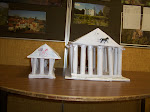
Please remember to bring in your signed syllabus form!
Your First Homework Assigment:
Read Pages
BB (Big Book) 25-37
or
LB (Little Book) 27-36
Then, complete a glossary enter for each of the following names
Glossary 1 Names
Part 1:
Zeus, Hera, Poseidon, Hades, Athena, Apollo, Artemis, Aphrodite, Hermes, Ares, Hephaestus, Hestia
Sample Glossary Entry:
Zeus- Chief Olympian god, who is the brother of both Hades and Poseidon. He is considered the Lord of the Sky, the Rain God, and the Thunderbolt. He is not a perfect god, and can often be deceived. He is known for having lots of affairs with women. His bird is the eagle and his tree is the oak.
Note: The more you write on each name, the more likely you are to receive bonus sheep!
NOTE: If you were absent on the first day, you will need to complete the following survey and turn it in to me. Also, you should complete this pretest before doing any reading in the book.
Thursday, September 10, 2009
Thursday, May 21, 2009
Expository Paper due 5/29(B) or 5/30(A)
For the final copy of your paper, you will need to include and introduction and a conclusion. Below you will find some suggestions for an introduction. A conclusion should be about the same length, repeat the thesis and paragraph topics, and then made some extension to broader ideas that your paper has helped reveal.
Your introduction to your expository paper should be about 5-6 sentences long. The last sentence should present the thesis of your paper: One of the ways Greeks used Mythology was to explain the natural world around them. Of course, you’ll want to phrase this in your own words. The final sentence should also present the paragraph topics or categories of your discussion: Plants, Animals, Trees, Geographical locations, etc.
Your first 4-5 sentences should present background information that is in some way connected to your paper. You might consider a few sentences on
• Basic information about Greek gods and goddesses
• Comments on mankind’s desire to explain things
• Reflections on different types of Mythology in the world
• Contrasts to how mankind uses science to explain elements of the world today
There are many possible options, so this list does not present your only possibilities. Also, remember this is formal voice, so you still want to avoid the pronouns “I, you, we, our”.
Your introduction to your expository paper should be about 5-6 sentences long. The last sentence should present the thesis of your paper: One of the ways Greeks used Mythology was to explain the natural world around them. Of course, you’ll want to phrase this in your own words. The final sentence should also present the paragraph topics or categories of your discussion: Plants, Animals, Trees, Geographical locations, etc.
Your first 4-5 sentences should present background information that is in some way connected to your paper. You might consider a few sentences on
• Basic information about Greek gods and goddesses
• Comments on mankind’s desire to explain things
• Reflections on different types of Mythology in the world
• Contrasts to how mankind uses science to explain elements of the world today
There are many possible options, so this list does not present your only possibilities. Also, remember this is formal voice, so you still want to avoid the pronouns “I, you, we, our”.
Wednesday, May 20, 2009
Due Thursday/Friday 5/21-22
House of Atreus Questions
House of Atreus Questions
Pages 345-371; 247-265
1. What does Tantalus do to begin the curse that will plague the rest of the House of Atreus?
2. How is Pelops injured and how does he recover?
3. Who are the sons of Pelops?
4.. What conflict do these two sons have with each other?
5. How does Atreus get revenge on his brother? (This is sometimes called the “unholy banquet.”
5. Who is Agamemnon’s father? Who is Agamemnon’s wife? What are the names of their children?
6. What did Agamemnon do before he could sail for Troy? Why did he have to do this? (Review question)
7. Who does Agamemnon’s wife begin a relationship with during his absence? Who is this person related to?
8. There are two different versions of how Agamemnon dies when he returns from Troy. What are they?
9. How is Clytemnestra’s role in this event explained? In other words, why does she not feel guilty for doing what happens?
10. Who does Agamemnon bring back from Troy with him? What is her “unusual” gift? (Review Question)
11. What is Orestes’ conflict after the murder of his father? Whom does he ask for help?
12. How do Orestes and his cousin Pylades try to deceive his mother?
13. How is Orestes tormented immediately after killing his mother? What are these creatures called? Where does he go?
14. Years later, whom does Orestes plead his case to? (ask for help)
15. What are the results of this “trial”? What happens to the Furies?
Iphigenia among the Taurians
16. In Euripedes version of the story, what “really” happened to Iphigenia at Aulis?
17. What did Iphigenia have to do when she was living with the Taurians that was so horrible?
18. What two people is she supposed to kill?
19. How does Iphigenia, along with her companions, plan their escape?
20. What almost ruins their escape plans? What finally puts an end to their suffering?
21. What are your feelings about the changes Euripedes made to the story of Iphigenia?
House of Atreus Questions
Pages 345-371; 247-265
1. What does Tantalus do to begin the curse that will plague the rest of the House of Atreus?
2. How is Pelops injured and how does he recover?
3. Who are the sons of Pelops?
4.. What conflict do these two sons have with each other?
5. How does Atreus get revenge on his brother? (This is sometimes called the “unholy banquet.”
5. Who is Agamemnon’s father? Who is Agamemnon’s wife? What are the names of their children?
6. What did Agamemnon do before he could sail for Troy? Why did he have to do this? (Review question)
7. Who does Agamemnon’s wife begin a relationship with during his absence? Who is this person related to?
8. There are two different versions of how Agamemnon dies when he returns from Troy. What are they?
9. How is Clytemnestra’s role in this event explained? In other words, why does she not feel guilty for doing what happens?
10. Who does Agamemnon bring back from Troy with him? What is her “unusual” gift? (Review Question)
11. What is Orestes’ conflict after the murder of his father? Whom does he ask for help?
12. How do Orestes and his cousin Pylades try to deceive his mother?
13. How is Orestes tormented immediately after killing his mother? What are these creatures called? Where does he go?
14. Years later, whom does Orestes plead his case to? (ask for help)
15. What are the results of this “trial”? What happens to the Furies?
Iphigenia among the Taurians
16. In Euripedes version of the story, what “really” happened to Iphigenia at Aulis?
17. What did Iphigenia have to do when she was living with the Taurians that was so horrible?
18. What two people is she supposed to kill?
19. How does Iphigenia, along with her companions, plan their escape?
20. What almost ruins their escape plans? What finally puts an end to their suffering?
21. What are your feelings about the changes Euripedes made to the story of Iphigenia?
Friday, May 15, 2009
Due Tuesday/Wednesday
Read parts 1 and 2 of the Adventures of Aeneas.
Make sure you have completed and turned in body paragraphs 1 and 2.
Make sure if you are bringing the pestilence upon your polis that you complete glossary 2 and unit 2 notecards (see the post for April 16th)
Make sure you have completed and turned in body paragraphs 1 and 2.
Make sure if you are bringing the pestilence upon your polis that you complete glossary 2 and unit 2 notecards (see the post for April 16th)
Monday, May 4, 2009
Updates
We've been working on the story of the Trojan War in class, and if you have been absent, you will want to get notes from a polis member or read the chapter in your book.
We've also had our first battle, so you may want to check out the polis homepage for the results. A link is available on the left.
We've also had our first battle, so you may want to check out the polis homepage for the results. A link is available on the left.
Thursday, April 16, 2009
Unit 2 Test Monday April 20 or Tuesday April 21
Remember for the test you can use ONE side of a 3x5 inch card to help you on the test.
Make sure to bring your Unit 2 Flashcards AND your Glossary 2.
Glossary 2 Names: (page numbers correspond to the Big Book)
Polyphemus (105); Hospitality Law; Narcissus (111); Hyacinthus (115); Adonis (117); Otus and Ephialtes (190); Daedalus 192); Golden Mean; Deus ex Machina; 7 out of the 8 tales of lovers (135-158)
16 Total Entries
Make sure to bring your Unit 2 Flashcards AND your Glossary 2.
Glossary 2 Names: (page numbers correspond to the Big Book)
Polyphemus (105); Hospitality Law; Narcissus (111); Hyacinthus (115); Adonis (117); Otus and Ephialtes (190); Daedalus 192); Golden Mean; Deus ex Machina; 7 out of the 8 tales of lovers (135-158)
16 Total Entries
Tuesday, April 7, 2009
Hero Story Update
Hero's storys were due Monday and Tuesday. Many people received 40 personal gold for turning them in, and a few lucky polises (Sparta 8, Sparta 1 and Argos 1) received bonus gold for having all members prepared with their assignments.
If your hero story is not done, you need to turn it in Wednesday or Thursday.
Also, you need to turn in your chart of 10 changes to the movie Clash of the Titans that made it match our modern expectations of an action movie.
If your hero story is not done, you need to turn it in Wednesday or Thursday.
Also, you need to turn in your chart of 10 changes to the movie Clash of the Titans that made it match our modern expectations of an action movie.
Subscribe to:
Posts (Atom)